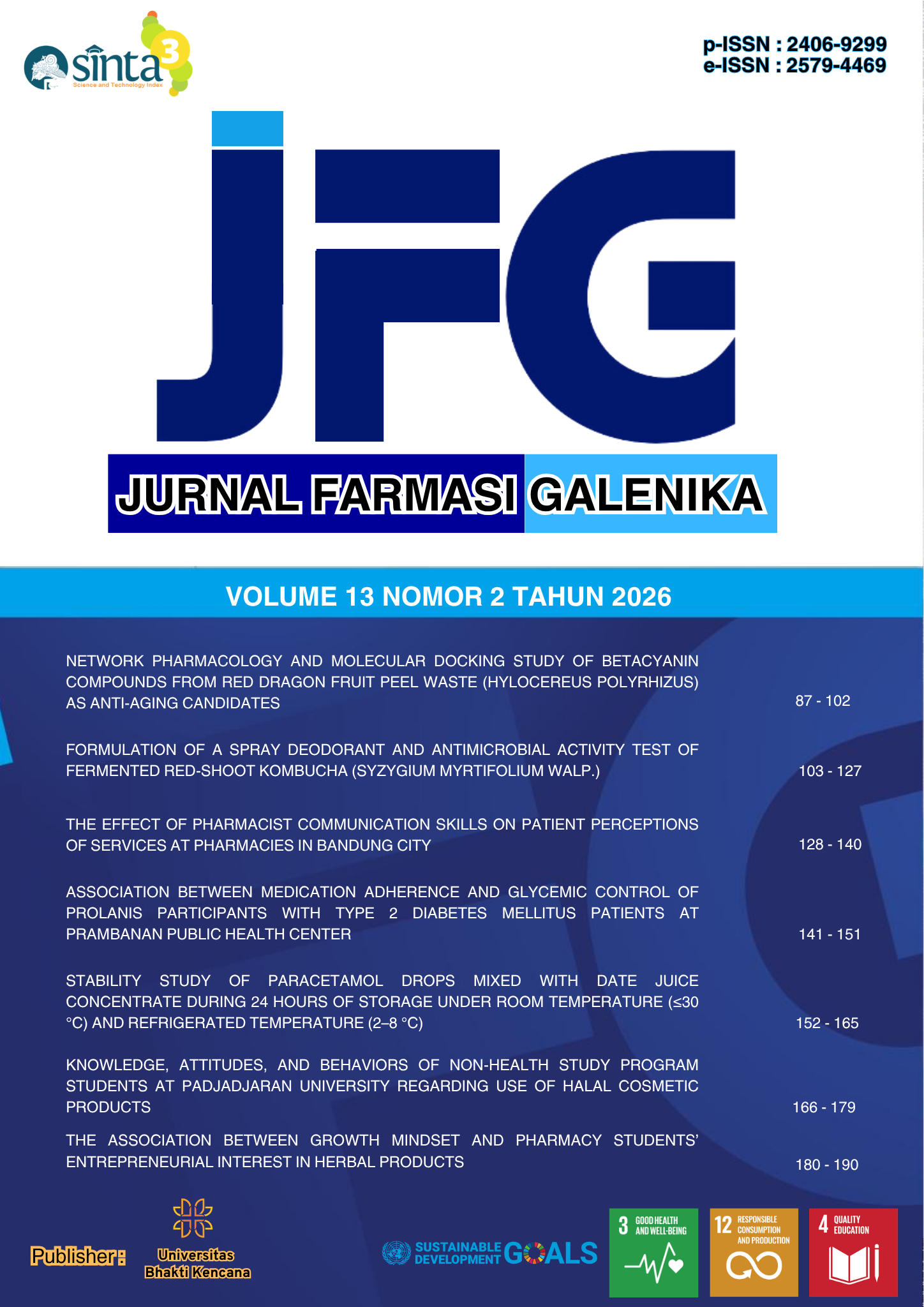
Formulation of A Spray Deodorant and Antimicrobial Activity Test of Fermented Red-Shoot Kombucha (Syzygium myrtifolium Walp.)
DOI:
https://doi.org/10.70410/jfg.v13i2.460Keywords:
antimicrobial, deodorant spray, kombucha fermentation, Syzygium myrtifolium Walp.Abstract
Antimicrobial deodorants offer a viable solution for managing body odor. The red shoot plant (Syzygium myrtifolium Walp.) contains bioactive compounds with promising antimicrobial properties, providing a natural alternative that circumvents the long-term health risks associated with synthetic agents. Furthermore, kombucha fermentation can break down these complex phytochemicals into simpler molecules while triggering the synthesis of novel organic acids, thereby enhancing both the bioactivity and dermal penetration of the plant's active constituents. This study aimed to develop a spray deodorant formulation utilizing red shoot extracts fermented with a kombucha culture for 12 days. The antimicrobial efficacy of the formulation was evaluated against Escherichia coli, Staphylococcus aureus, and Candida albicans via UV-Vis spectrophotometry at 600 nm for bacteria and 580 nm for fungi. The results indicated that the fermented extract exhibited moderate inhibitory activity, yielding inhibition rates of 42.36% against E. coli, 38.51% against S. aureus, and 35.66% against C. albicans. The spray deodorants were formulated with varying concentrations of propylene glycol (5, 10, and 15%) as an excipient. Physical and safety evaluations encompassed organoleptic properties, pH, viscosity, skin irritation, drying time, and spray patterns. Among the preparations, Formula 3 (F3) demonstrated the most optimal antimicrobial performance, maintained favorable physical stability, and induced no skin irritation. Consequently, this formulation holds significant potential for further development, specifically by optimizing the active ingredient concentration to maximize its antimicrobial efficacy.
Downloads
References
Adamczak, A., O?arowski, M., & Karpi?ski, T. M. (2020). Antibacterial activity of some flavonoids and organic acids widely distributed in plants. Journal of Clinical Medicine, 9(1). https://doi.org/10.3390/jcm9010109
Rezaldi, F., & Florida N. A. (2025). Formulasi sediaan spray alami dari limbah kombucha bunga telang sebagai produk bioteknologi pertanian dan farmasi dalam menghambat pertumbuhan jamur patogen pada jambu air (Syzygium aqueum). Jurnal Agroteknologi, 4(1).
Aldila, S., Bellasaeca, V., Saptawati, T., Dewi, R. S. (2023). Formulasi dan evaluasi sediaan hand cream ekstrak etanol brokoli (Brassica oleracea L.). Journal of Pharmaceutical and Sciences, 6(3), 1238-1242.
Asri, M. S., Wahid, H., Auliah, N., Selatan, S., Formulasi dan uji aktivitas antibakteri sediaan deodoran spray fraksi etil asetat daun jamblang (Syzygium cumini) terhadap Staphylococcus epidermidis. Archives Pharmacia, 8(1).
Astutiningsih, C., Setyani, W., Hindratna, H., Tinggi, S., Farmasi, I., Pharmasi’’, Y., Letjen, J., Edhi, S., Km-, W., & Semarang, P. (2014). Uji daya antibakteri dan identifikasi isolat senyawa katekin dari daun teh (Camellia sinensis L. var Assamica), 11(2), 50–57.
Az-Zahro, S. A. J., Umami, S. H., Hasanah, U., & Wijayanti, E. D. (2019). Aktivitas antihiperurisemia teh asam daun tin (Ficus carica) terhadap tikus putih (Rattus norvegicus). Kartika : Jurnal Ilmiah Farmasi, 7(1), 22–26. https://doi.org/10.26874/kjif.v7i1.176
Bakti Kurniawan, F., Haratati, R., Hermawardhani, A., Taufik Sahli, I., Ayu Puspasari, M., Dewi Kok Mesa, N., & Kesehatan Kemenkes Jayapura, P. (2026). Uji Aktivitas Antibakteri Kombucha Teh Rosella Terhadap Bakteri Staphylococcus Aureus. In Health Research Journal of Indonesia (HRJI) (Vol. 4, Number 4).
Balouiri, M., Sadiki, M., & Ibnsouda, S. K. (2016). Methods for in vitro evaluating antimicrobial activity: A review. In Journal of Pharmaceutical Analysis (Vol. 6, Number 2, pp. 71–79). Xi’an Jiaotong University. https://doi.org/10.1016/j.jpha.2015.11.005
Badan Pengawas Obat dan Makanan Republik Indonesia. (2022). Peraturan Badang Pengawas Obat dan Makanan Nomor 10 Tahun 2022 tentang Pedoman Uji Toksisitas Praklinik Secara In Vivo. JDIH BPOM.
Cappuccino, J. G., & Welsh, C. T. (2019). Microbiology: A laboratory manual (12th ed.). Pearson.
Chong, A. Q., Chin, N. L., Talib, R. A., & Basha, R. K. (2024). Modelling pH Dynamics, SCOBY Biomass Formation, and Acetic Acid Production of Kombucha Fermentation Using Black, Green, and Oolong Teas. Processes, 12(7). https://doi.org/10.3390/pr12071301
Destriawan, A., Mulyani, R., & Muharam, S. (2023). Uji aktivitas Antibakteri ekstrak daun jelantir (Conyza sumatrensis (Retz.) E. Walker) dalam sediaan deodoran spray terhadap bakteri Staphylococcus epidermidis. Jurnal Ilmiah Ibnu Sina (JIIS): Ilmu Farmasi Dan Kesehatan, 8(2), 276–285. https://doi.org/10.36387/jiis.v8i2.1458
Dickwella Widanage, M. C., Singh, K., Li, J., Yarava, J. R., Scott, F. J., Xu, Y., Gow, N. A. R., Mentink-Vigier, F., Wang, P., Lamoth, F., & Wang, T. (2025). Distinct echinocandin responses of Candida albicans and Candida auris cell walls revealed by solid-state NMR. Nature Communications , 16(1). https://doi.org/10.1038/s41467-025-61678-1
Firdaus, S., Indah, A., Isnaini, L., & Aminah, S. (2020). “Review” Teh Kombucha Sebagai Minuman Fungsional dengan Berbagai Bahan Dasar Teh “Review” Kombucha Tea As A Functional Beverage With Various Tea Bases. Retrieved http://prosiding.unimus.ac.id
Firdhauzi, A., Saputri, W. L., Suhartatik, N., & Mustofa, A. (2025). Pemanfaatan Rempah Tradisional dalam Peningkatan Mutu dan Daya Simpan Geplak Sirsak (Annona muricata). AGRITEKNO: Jurnal Teknologi Pertanian, 14(2), 156–166. https://doi.org/10.30598/jagritekno.2025.14.2.156
Safitri, N., Yuniarti, R., Dalimunthe, G. I., & Lubis, M. S. (2020). Evaluation of Physical Quality, Moisture Test, and Potential Activity of Lip Balm Sunscreen from Ethanol Extract of Red Shoot Leaves (Syzygium myrtifolium Walp.). Journal of Pharmaceutical and Sciences JPS, 2025(4), 2262–2275. https://doi.org/10.36490/journal-jps.com
Guspratiwi, R., Tono Taufiq, T., Bayu Handika, D., Pengaruh Lama Fermentasi terhadap Profil Sensori, pH, dan Aktivitas Antioksidan Kombucha Teh Daun Kelor (Moringa oleifera). J. Sains Dan Teknologi Pangan, 10(2), 8331–8339.
Puspaningrum, D. H. D., Sumadewi, N. L. U., & Sari, N. K. Y. (2022). Kandungan Total Asam, Total Gula, dan nilai pH Kombucha Cascara Kopi Arabika Desa Catur Bangli Selama Fermentasi. Prosiding SINTESA, 4, 149-156.
Hidayati, N., Budiman, H., & Sarmini, S. (2024). Uji Aktivitas Antibakteri Deodorant Spray Tea Tree Oil (Melaleuca alternifolia) Terhadap Staphylococcus aureus. Journal of Herbal, Clinical and Pharmaceutical Science (HERCLIPS), 6(01), 30. https://doi.org/10.30587/herclips.v6i01.8244
Hijra, H. N. H., Zahran, I., & Amri, S. R. (2024). Formulasi dan Uji Aktivitas Antibakteri Deodoran Spray Alami Kombinasi Ekstrak Daun Senggani (Melastoma malabathricum L.) dan Daun Bidara (Ziziphus mauritiana L.). Jurnal Mandala Pharmacon Indonesia, 10(1), 144–157. https://doi.org/10.35311/jmpi.v10i1.490
Huzaemah, S. H., Setiawan, A., & Puspitasari, R. (2024). Formulasi Sediaan Deodoran Spray Ekstrak Daun Mangkokan (Polyscias scutellaria (Burm.F.) Fosberg) dan Uji Efektivitas Antibakteri Staphylococcus epidermidis, 6(2).
Içen, H., Corbo, M. R., Sinigaglia, M., Korkmaz, B. I. O., & Bevilacqua, A. (2023). Microbiology and antimicrobial effects of kombucha, a short overview. In Food Bioscience (Vol. 56). Elsevier Ltd. https://doi.org/10.1016/j.fbio.2023.103270
Cholidah, A. I., Danu, D., Nurrosyidah, I. H (2020). Pengaruh Lama Waktu Fermentasi Kombucha Rosela (Hibiscus sabdariffa L.) terhadap Aktivitas Antibakteri Escherichia coli. Jurnal Riset Kefarmasian Indonesia, 2(3), 186-210.
Kementerian Kesehatan Republik Indonesia. (2017). Farmakope Herbal Indonesia (Edisi II). Kementerian Kesehatan Republik Indonesia.
Kementerian Kesehatan Republik Indonesia. (2020). Farmakope Indonesia (Edisi VI). Kementerian Kesehatan Republik Indonesia.
Lailiyah, M., Sukmana, P. H., Yudha, E., Ilmu, I., Bhakti, K., & Kediri, W. (2019). Formulasi Deodoran Roll On Ekstrak Daun Waru (Hibiscus tiliaceus L.) pada Konsentrasi 3%; 5%; 8% dan Uji Aktivitas terhadap Staphylococcus aureus. Cendekia Journal of Pharmacy STIKES Cendekia Utama Kudus, 3(2). http://cjp.jurnal.stikescendekiautamakudus.ac.id
Monton, C., Wunnakup, T., Suksaeree, J., Charoenchai, L., & Chankana, N. (2020). Investigation of the Interaction of Herbal Ingredients Contained in Triphala Recipe Using Simplex Lattice Design: Chemical Analysis Point of View. International Journal of Food Science, 2020. https://doi.org/10.1155/2020/5104624
Novitasari, D. E., & Dyah Wijayanti, E. (2018). Aktivitas Antimikroba Teh Asam Daun Tin (Ficus Carica) Secara In Vitro. Journal Cis-Trans (JC-T), 2(2), 25-29.
Patandung, R., Ilah Rahmadani, N., Irna Luthfy, L., Ariastuti, R., Studi Farmasi, P., Sains, F., & Kesehatan, dan. (2026). Formulasi dan Evaluasi Fisik Deodorant Spray Ekstrak Syzygium aromaticum dengan Variasi Tawas. Health Research Journal of Indonesia (HRJI), 4(5).
Pratiwi, D. I., & Sholikhah, M. (2026). Formulasi Dan Evaluasi Deodoran Spray Ekstrak Daun Rambutan (Nephelium lappaceum L.) Dengan Variasi Aluminium Kalium Sulfat Sebagai Antirespiran. Jurnal Kesehatan Farmasi Nusantara, 2(1), 1–13. https://doi.org/10.64465/jkfn.v2i1.63
Putri, M. K., Rumyaan, E. F., & Sari, E. K. (2025). Formulasi dan Uji Aktivitas Antibakteri Sediaan Hand Sanitizer Ekstrak Etanol Daun Salam terhadap Bakteri Staphylococcus aureus. Jurnal Ilmiah Farmasi Farmasyifa, 8(1), 73–82. https://doi.org/10.29313/jiff.v8i1.4413
Rahmanda, D., Khasanah, H. R., & Krisyanella. (2024). Formulasi dan Uji Aktivitas Sediaan Deodoran Spray Ekstrak Etanol Bunga Kecombrang (Etlingera elatior (Jack)) terhadap Bakteri Staphylococcus epidermidis. Jurnal Pharmacopoeia, 3(1), 33-43.
Sari, R. (2025). Pembuatan Deodoran Spray Alami Berbasis Daun Sirih Hijau (Piper Betle L.). Jurnal Teknologi, 25(1).
Siddiqui, S., & Pannu, J. (2026). Glycol vapor pathogen disinfection: a defensive technology for emerging biothreats. Frontiers in Microbiology, 17. https://doi.org/10.3389/fmicb.2026.1843269
Sinawe H, Casadesus D. Ketoconazole. [Updated 2023 Jun 26]. In: StatPearls [Internet]. Treasure Island (FL): StatPearls Publishing; 2026 Jan-. Available from: https://www.ncbi.nlm.nih.gov/books/NBK559221/
Suhardini, P. N., & Zubaidah, E. (2016). Studi Aktivitas Antioksidan Kombucha dari Berbagai Jenis Daun Selama Fermentasi. Jurnal Pangan dan Agroindustri, 4(1), 221-229.
Suryana, S., Anindia Hermawan, B., & Aulia Ramadhanty, D. (2025). Aktivitas Antimikroba Fraksi Daun Pucuk Merah (Syzygium myrtifolium (Roxb.) Walp. terhadap Escherichia coli dan Staphylococcus aureus dengan Metode Mikrodilusi M07-A6 CLSI. Pharmacoscript, 101-115.
Syaputri, N. L., Retnaningsih, A., Ayu, G., & Saputri, R. (2026). Formulation and Activity Test of A Spray Deodorant Preparation from A Combination of Orange Peel Essential Oil and Basil Leaf Extract on Staphylococcus aureus Bacteria. Jurnal Analisis Farmasi, 11(1), 100-113.
Vohra, S., Patel, R., Patil, P. (2026). Topical Film-Forming Sprays: An Emerging Approach in Dermal Therapy. International Journal of Pharmaceutical Sciences, 4(1), 1481–1494. https://doi.org/10.5281/zenodo.18256854
Wahyudi, I., Lisdiana, L., & Astuti, B. (2023). Karakteristik Kombucha dengan Penambahan Ekstrak Kayu Manis (Cinnamomum burmannii) dan Kayu Secang (Caesalpinia sappan) pada Proses Fermentasi Sekunder. Rekayasa, 16(3), 351–358. https://doi.org/10.21107/rekayasa.v16i3.17791
Wahyuni, S., Bayu Budiyanto, A., & Sorong, M. (2026). Uji Daya Hambat Ekstrak Daun Pucuk Merah (S. oleana) terhadap Pertumbuhan Bakteri Staphylococcus aureus. Jurnal Kesehatan Tambusai, 7(2), 6361-6369.
Yuan, J., Nie, Q., Pan, W., Liu, Z., Wu, J., Liu, Z., & Cai, S. (2025). Microbial composition, bioactive compounds, and sensory evaluation of Kombucha prepared with green tea and black tea. Beverage Plant Research, 5. https://doi.org/10.48130/bpr-0025-0001
Yuniarsih, N., Farhamzah, F., & Wulansari, N. I. (2025). Formulasi dan Uji Aktivitas Antioksidan Sediaan Face Mist Fraksi Daun Lidah Mertua (Sansevieria trifasciata Prain). Jurnal Buana Farma, 5(2). https://doi.org/10.36805/jbf.v5i2.1475
Yuningtyas, S., Masaenah, E., & Telaumbanua, M. (2021). Aktivitas Antioksidan, Total Fenol, dan Kadar Vitamin C dari Kombucha Daun Salam (Syzygium polyanthum (Wight) Walp.). Jurnal Farmamedika, 6(1).
Downloads
Published
How to Cite
Issue
Section
Citation Check
License
Copyright (c) 2026 Rahma Ziska, M Ramadhan Saputro, Khilal Farza

This work is licensed under a Creative Commons Attribution 4.0 International License.
Authors who publish in Jurnal Farmasi Galenika agree to the following terms:
This license enables reusers to distribute, remix, adapt, and build upon the material in any medium or format, so long as attribution is given to the creator. The license allows for commercial use. CC BY includes the following elements:

BY: credit must be given to the creator.
You are free to:
- Share — copy and redistribute the material in any medium or format for any purpose, even commercially.
- Adapt — remix, transform, and build upon the material for any purpose, even commercially.
- The licensor cannot revoke these freedoms as long as you follow the license terms.
Under the following terms:
- Attribution — You must give appropriate credit , provide a link to the license, and indicate if changes were made . You may do so in any reasonable manner, but not in any way that suggests the licensor endorses you or your use.
- No additional restrictions — You may not apply legal terms or technological measures that legally restrict others from doing anything the license permits.
Notices:
You do not have to comply with the license for elements of the material in the public domain or where your use is permitted by an applicable exception or limitation .
No warranties are given. The license may not give you all of the permissions necessary for your intended use. For example, other rights such as publicity, privacy, or moral rights may limit how you use the material.