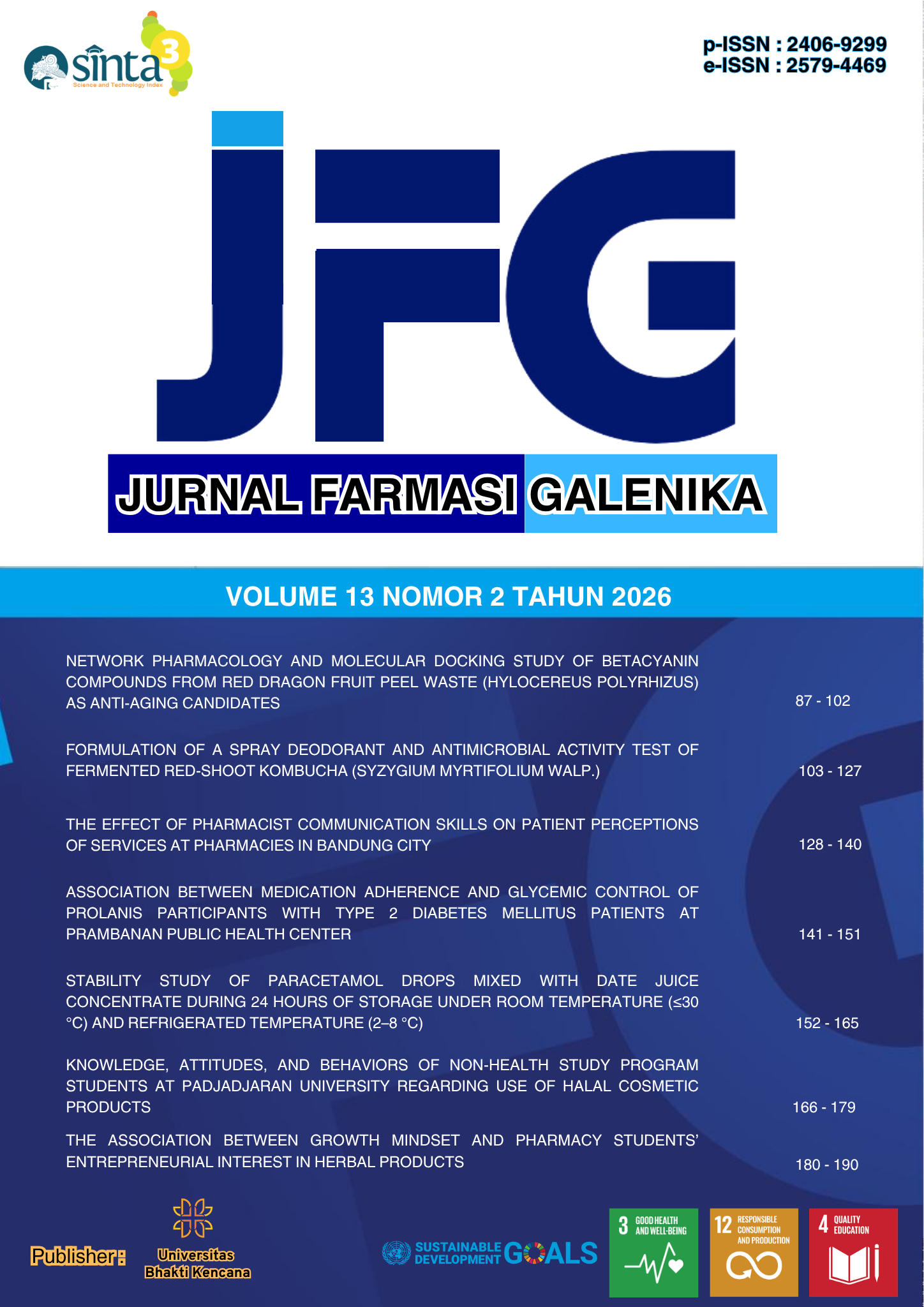
Association Between Medication Adherence and Glycemic Control of Prolanis Participants With Type 2 Diabetes Mellitus Patients at Prambanan Public Health Center
DOI:
https://doi.org/10.70410/jfg.v13i2.427Keywords:
diabetes mellitus, adherence, glycemic control, public health centerAbstract
Diabetes Mellitus (DM) is one of the four non-communicable diseases categorized as a top priority, requiring long-term management to prevent serious complications. Glycemic control is a critical factor in managing the disease, yet medication non-adherence remains a significant challenge. The Chronic Disease Management Program (Prolanis) aims to optimize participants' quality of life via BPJS Kesehatan (National Health Insurance provider). This study aimed to determine the relationship between therapeutic adherence and glycemic control among Type 2 Diabetes Mellitus (T2DM) Prolanis participants at the Prambanan Public Health Center, Sleman. This observational study employed a cross-sectional design and included 34 participants who met the inclusion and exclusion criteria. The results indicated that the majority of participants—21 individuals (61.8%)—were non-adherent to therapy, with 12 of them (57.1%) having uncontrolled glycemic levels. Among the 13 participants (38.2%) who adhered to therapy, 11 (84.6%) achieved controlled glycemic levels. There was an association between therapeutic adherence and glycemic control in T2DM Prolanis participants at the Prambanan Public Health Center, Sleman.
Downloads
References
American Diabetes Association Professional Practice Committee. (2023). 6. Glycemic Goals and Hypoglycemia: Standards of Care in Diabetes—2024. Diabetes Care, 47(Supplement_1), S111–S125. https://doi.org/10.2337/dc24-S006
Ananda, R. D. S., Pratiwi, W. R., & Kristin, E. (2019). Adherence and Glycemic Control Among Type 2 Diabetes Mellitus Patients Using Antidiabetic Medication: A Cross Sectional Study on Population Registered in Sleman Health and Demographic Surveillance System. J. Pharm. Sci., 11. Available at : https://www.proquest.com/openview/e125332770c654d8aaef48a77e95a1e4/1?pq-origsite=gscholar&cbl=54977
Apristina, A., Nurinda, E., Kusumawardani, N., Yugistyowati, A., & Dwinta, E. (2023). Analisis Hubungan Tingkat Kepatuhan Penggunaan Obat terhadap Luaran Klinis Pasien PROLANIS Program Rujuk Balik Diabetes dengan Hipertensi di Puskesmas Minggir pada Masa Pandemi COVID-19: Tingkat Kepatuhan Penggunaan Obat terhadap Luaran Klinis Pasien PROLANIS Diabetes dengan Hipertensi di Masa Pandemi COVID-19. Pharmaceutical Journal of Indonesia, 8(2). https://doi.org/10.21776/ub.pji.2023.008.02.6
Arfania, M., Hidayat, S. Z. P. H. Z. P., & Amal, S. (2022). FAKTOR YANG MEMPENGARUHI KEPATUHAN PENGOBATAN DIABETES MELITUS TIPE 2 DI RUMAH SAKIT SWASTA KARAWANG. Journal of Pharmacopolium, 5(3). https://doi.org/10.36465/jop.v5i3.913
Badan Penelitian dan Pengembangan Kesehatan, -. (2020). Laporan Nasional Riskesdas 2018. https://repository.badankebijakan.kemkes.go.id/id/eprint/3514/
Bonger, Z., Shiferaw, S., & Tariku, E. Z. (2018). Adherence to diabetic self-care practices and its associated factors among patients with type 2 diabetes in Addis Ababa, Ethiopia. Patient Preference and Adherence, 12, 963–970. https://doi.org/10.2147/PPA.S156043
Elm, E. von, Altman, D. G., Egger, M., Pocock, S. J., Gøtzsche, P. C., Vandenbroucke, J. P., & Initiative, for the S. (2007). The Strengthening the Reporting of Observational Studies in Epidemiology (STROBE) Statement: Guidelines for Reporting Observational Studies. PLOS Medicine, 4(10), e296. https://doi.org/10.1371/journal.pmed.0040296
Fandinata, S. S., & Darmawan, R. (2020). Pengaruh Kepatuhan Minum Obat Oral Anti Diabetik Terhadap Kadar Gula Darah Pada Pasien Diabetes Mellitus Tipe II. Jurnal Bidang Ilmu Kesehatan, 10(1), 23–31. https://doi.org/10.52643/jbik.v10i1.825
Ginting, S., Tampubolon, E. M., & Batubara, S. (2020). FAKTOR FAKTOR YANG MEMENGARUHI KEIKUTSERTAAN PESERTA BPJS MELAKUKAN SENAM PROLANIS DI PUSKESMAS MARTIMBANG KOTA PEMATANGSIANTAR TAHUN 2017. Jurnal Inovasi Kesehatan Masyarakat, 1(2), 46–51. https://doi.org/10.36656/jikm.v1i2.265
Husna, A. H., Jafar, N., Hidayanty, H., M.Dachlan, D., & Salam, A. (2022). HUBUNGAN KEPATUHAN MINUM OBAT DENGAN GULA DARAH PASIEN DM TIPE II DI PUSKESMAS TAMALANREA MAKASSAR: HUBUNGAN KEPATUHAN MINUM OBAT DENGAN GULA DARAH PASIEN DM TIPE II DI PUSKESMAS TAMALANREA MAKASSAR. Jurnal Gizi Masyarakat Indonesia (The Journal of Indonesian Community Nutrition), 11(1). https://doi.org/10.30597/jgmi.v11i1.20702
Kardela, W., Agustina, E., Harartasyahrani, R. A., & Bellatasie, R. (2023). Korelasi Tingkat Kepatuhan Pengobatan terhadap Kadar Glukosa Darah pada Pasien Geriatri Diabetes Melitus Tipe 2 di Puskesmas Kota Padang: Correlation of Medication Adherence to Blood Glucose Levels among Geriatric Patients with Type 2 DM at Health Center in Padang. JOPS (Journal of Pharmacy and Science), 6(2), 184–197. https://doi.org/10.36341/jops.v6i2.3504
Kementrian Kesehatan RI. (2013). Laporan Riskesdas Tahun 2013. Badan Penelitian dan Pengembangan Kesehatan, Kementerian Kesehatan RI.
Ningrum, V. D. A., Ikawati, Z., Sadewa, A. H., & Ikhsan, M. R. (2017). Kontrol Glikemik dan Prevalensi Gagal Ginjal Kronik pada Pasien Diabetes Melitus Tipe 2 di Puskesmas Wilayah Provinsi DIY Tahun 2015. Indonesian Journal of Clinical Pharmacy, 6(2), 78–90. https://doi.org/10.15416/ijcp.2017.6.2.78
Noviyantini, N. P. A., Wicaksana, A. L., & Pangastuti, H. S. (2020). Kualitas Hidup Peserta Prolanis Diabetes Tipe 2 di Yogyakarta. Jurnal Persatuan Perawat Nasional Indonesia (JPPNI), 4(2), 98–107. https://doi.org/10.32419/jppni.v4i2.183
Polonsky, W. H., & Henry, R. R. (2016). Poor medication adherence in type 2 diabetes: Recognizing the scope of the problem and its key contributors. Patient Preference and Adherence, 10, 1299–1307. https://doi.org/10.2147/PPA.S106821
Putri, E. D. M., Ananda, R. D. S., Nurinda, E., & Wulandari, A. S. (2024). HUBUNGAN ANTARA KONTROL GLIKEMIK DENGAN TINGKAT KUALITAS HIDUP PESERTA PROLANIS PENDERITA DIABETES MELITUS TIPE 2 DI PUSKESMAS PRAMBANAN SLEMAN. Jurnal Insan Farmasi Indonesia, 7(3), 259–268. https://doi.org/10.36387/jifi.v7i3.2167
Ratnasari, P. M. D., Ardeliani, I. G. A. I., & Yuliawati, A. N. (2021). ANALISIS HUBUNGAN KEPATUHAN PENGOBATAN TERHADAP KONTROL GLIKEMIK PASIEN DIABETES MELITUS TIPE 2 DI INSTALASI RAWAT JALAN RUMAH SAKIT “X†BULELENG. JIIS (Jurnal Ilmiah Ibnu Sina): Ilmu Farmasi dan Kesehatan, 6(2), 331–340. https://doi.org/10.36387/jiis.v6i2.739
Rusminingsih, E., & Purnomo, R. T. (2022). Relationship of Patient Characteristics with Medication Adherence in Type 2 DM. Indonesian Journal of Global Health Research, 4(3), 603–610. https://doi.org/10.37287/ijghr.v4i3.1316
Saeedi, P., Petersohn, I., Salpea, P., Malanda, B., Karuranga, S., Unwin, N., Colagiuri, S., Guariguata, L., Motala, A. A., Ogurtsova, K., Shaw, J. E., Bright, D., Williams, R., & IDF Diabetes Atlas Committee. (2019). Global and regional diabetes prevalence estimates for 2019 and projections for 2030 and 2045: Results from the International Diabetes Federation Diabetes Atlas, 9th edition. Diabetes Research and Clinical Practice, 157, 107843. https://doi.org/10.1016/j.diabres.2019.107843
Silalahi, L. (2019). Hubungan Pengetahuan dan Tindakan Pencegahan Diabetes Mellitus Tipe 2. Jurnal Promkes: The Indonesian Journal of Health Promotion and Health Education, 7(2), 223–232. https://doi.org/10.20473/jpk.V7.I2.2019.223-232
Umsipyat, A. S., Ananda, R. A. D. S., Nurinda, E., & Wulandari, A. S. (2025). The Perbandingan Kualitas Hidup Peserta Prolanis Diabetes Melitus Tipe 2 yang Memperoleh Monoterapi dan Politerapi di Puskesmas Prambanan Sleman. Journal of Pharmaceutical and Sciences, 1732–1739. https://doi.org/10.36490/journal-jps.com.v8i3.588
Vandenbroucke, J. P., Elm, E. von, Altman, D. G., Gøtzsche, P. C., Mulrow, C. D., Pocock, S. J., Poole, C., Schlesselman, J. J., Egger, M., & Initiative, for the S. (2007). Strengthening the Reporting of Observational Studies in Epidemiology (STROBE): Explanation and Elaboration. PLOS Medicine, 4(10), e297. https://doi.org/10.1371/journal.pmed.0040297
Wahyudi, Andrey., & Arifah, N. (2019). Asosiasi Kepatuhan Terhadap Luaran Terapi Pada Pasien Diabetes Mellitus Tipe II Di RSUD Wirosaban Kota Yogyakarta. Indonesian Journal of Pharmacy and Natural Product, 02, 4–7. https://doi.org/https://doi.org/10.35473/ijpnp.v5i1.1567
Wicaksana, A., & Rachman, T. (2023). Profil Kesehatan D.I.Yogyakarta Tahun 2022. Angewandte Chemie International Edition, 6(11), 951–952., 3(1), 10–27. Available at : https://kesehatan.jogjakota.go.id/uploads/dokumen/profil_dinkes_2022_data_2021_fix.pdf
Downloads
Published
How to Cite
Issue
Section
Citation Check
License
Copyright (c) 2026 Amaliyah Nur Khasanah, RA Dewinta Sukma Ananda, Eva Nurinda, Ari Susiana Wulandari

This work is licensed under a Creative Commons Attribution 4.0 International License.
Authors who publish in Jurnal Farmasi Galenika agree to the following terms:
This license enables reusers to distribute, remix, adapt, and build upon the material in any medium or format, so long as attribution is given to the creator. The license allows for commercial use. CC BY includes the following elements:

BY: credit must be given to the creator.
You are free to:
- Share — copy and redistribute the material in any medium or format for any purpose, even commercially.
- Adapt — remix, transform, and build upon the material for any purpose, even commercially.
- The licensor cannot revoke these freedoms as long as you follow the license terms.
Under the following terms:
- Attribution — You must give appropriate credit , provide a link to the license, and indicate if changes were made . You may do so in any reasonable manner, but not in any way that suggests the licensor endorses you or your use.
- No additional restrictions — You may not apply legal terms or technological measures that legally restrict others from doing anything the license permits.
Notices:
You do not have to comply with the license for elements of the material in the public domain or where your use is permitted by an applicable exception or limitation .
No warranties are given. The license may not give you all of the permissions necessary for your intended use. For example, other rights such as publicity, privacy, or moral rights may limit how you use the material.