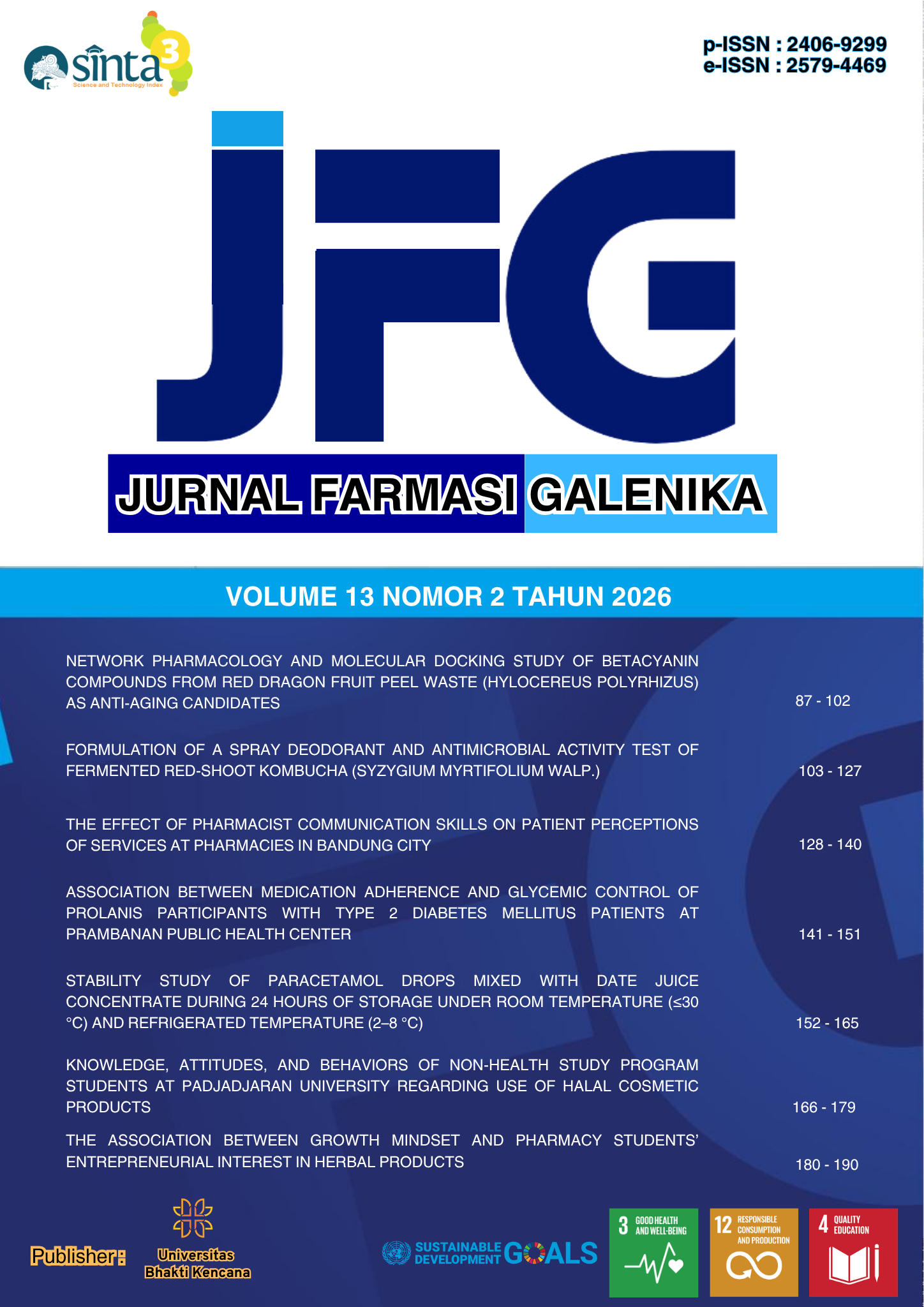
Network Pharmacology and Molecular Docking Study of Betacyanin Compounds from Red Dragon Fruit Peel Waste (Hylocereus polyrhizus) as Anti-Aging Candidates
DOI:
https://doi.org/10.70410/jfg.v13i2.422Keywords:
Anti-aging, betacyanin, Hylocereus polyrhizus, molecular docking, network pharmacologyAbstract
Red dragon fruit (Hylocereus polyrhizus) peel waste is an abundant but underutilized biomass rich in bioactive compounds with potential as anti-aging agents. Addressing this issue, this study introduces a novel in silico multi-target approach to explore the bioactive potential of this waste. The objective is to identify molecular targets and evaluate binding affinities using network pharmacology, molecular docking, and ADMET predictions. Network pharmacology analysis of nine test compounds identified an intersection of 70 anti-aging-related target proteins. Topological analysis established AKT1, SRC, and TNF as the main hub proteins. Molecular docking simulations demonstrated that phyllocactin consistently exhibited the most stable binding affinity toward all targets, with the lowest Rerank Score on the TNF receptor (-176.727 kcal/mol), showing in silico competitive potential surpassing its native ligand. ADMET predictions indicated that phyllocactin possesses a favorable safety profile, being non-hepatotoxic and non-mutagenic for topical applications. In conclusion, phyllocactin from dragon fruit peel waste holds significant potential as a multi-target anti-aging candidate, although these preliminary findings warrant further experimental validation.
Downloads
References
Daina, A., Michielin, O., & Zoete, V. (2019). SwissTargetPrediction: updated data and new interface for target prediction in small molecules. Nucleic Acids Research, 47(W1), W357-W364.
Dassault Systèmes. (2021). BIOVIA Discovery Studio Visualizer, Release 2021. San Diego: Dassault Systèmes.
Franceschi, C., Garagnani, P., Parini, P., Giuliani, C., & Santoro, A. (2018). Inflammaging: a new immune-metabolic viewpoint for age-related diseases. Nature Reviews Endocrinology, 14(10), 576-590.
Ginting, I., & Andry, M. (2023). Utilization of Red Dragon Fruit (Hylocereus polyrhizus) Skin Extract in Scrub Cream as a Natural Skin Moisturizer. Journal of Pharmaceutical and Sciences, 6(3), 1034–1049.
Liao, G., et al. (2020). Exploring the Potential Use of Hylocereus polyrhizus Peels as a Source of Cosmeceutical Sunscreen Agent for Its Antioxidant and Photoprotective Properties. Pharmaceuticals, 13(5), 103.
Madadi, E., Mazloum-Ravasan, S., Yu, J. S., Ha, J. W., Hamishehkar, H., & Kim, K. H. (2020). Therapeutic Application of Betalains: A Review. Plants, 9(9), 1219.
Mulatsari, E., Mumpuni, E., & Ramadhan, I. (2019). Skrining Virtual dan Elusidasi Moda Ikatan Senyawa dalam Bawang Putih (Allium sativum L.) sebagai Penghambat Reseptor Advanced Glycation End Products. Jurnal Ilmu Kefarmasian Indonesia, 17(2), 210-217.
Mumpuni, E., Girsang, E., & Hadiprasetyo, E. (2023). Formulation and Evaluation of Anti-aging Serum Containing a Combination of Mugwort (Artemisia capillaris) Extract and Vitamin C as an Antioxidant. Jurnal Kefarmasian Akfarindo, 8(1), 15-23.
Pires, D. E., Blundell, T. L., & Ascher, D. B. (2015). pkCSM: predicting small-molecule pharmacokinetic and toxicity properties using graph-based signatures. Journal of Medicinal Chemistry, 58(9), 4066-4072.
Prasetiyo, A., Luthfiana, D., Soleha, M., dkk. (2023). Network pharmacology and molecular docking study to reveal the potential anticancer activity of Oscillatoxin D, E, and F marine cytotoxins. Food Systems, 6(3), 365-389.
Puspitasari, S., Soemarie, Y. B., & Fadillah, A. (2025). Uji Aktivitas Antioksidan Dari Kulit Buah Naga Merah (Hylocereus polyrhizus). Journal Scientific of Mandalika (JSM), 6(4), 1061-1072.
Shannon, P., Markiel, A., Ozier, O., Baliga, N. S., Wang, J. T., Ramage, D., ... & Ideker, T. (2003). Cytoscape: a software environment for integrated models of biomolecular interaction networks. Genome Research, 13(11), 2498-2504.
Szklarczyk, D., Gable, A. L., Lyon, D., Junge, A., Wyder, S., Huerta-Cepas, J., ... & Mering, C. V. (2019). STRING v11: protein–protein association networks with increased coverage, supporting functional discovery in genome-wide experimental datasets. Nucleic Acids Research, 47(D1), D607-D613.
Thomsen, R., & Christensen, M. H. (2006). MolDock: a new technique for high-accuracy molecular docking. Journal of Medicinal Chemistry, 49(11), 3315-3321.
Wu, P., Ma, G., Zhu, X., & Gu, N. (2017). AKT and its related molecular feature in aged mice skin. PLOS ONE, 12(6), e0178969.
Yuna, P., Chiuman, L., & Ginting, C. N. (2023). Anti-Inflammatory Effect of Red Dragon Fruit (Hylocereus polyrhizus) Peel on Male White Rat. Jurnal Farmasi dan Ilmu Kefarmasian Indonesia, 10(1), 88-94.
Downloads
Published
How to Cite
Issue
Section
Citation Check
License
Copyright (c) 2026 Teguh Sugiarto, Andri Prasetiyo, Esti Mulatsari, Esti Mumpuni, Ichsan Kamal

This work is licensed under a Creative Commons Attribution 4.0 International License.
Authors who publish in Jurnal Farmasi Galenika agree to the following terms:
This license enables reusers to distribute, remix, adapt, and build upon the material in any medium or format, so long as attribution is given to the creator. The license allows for commercial use. CC BY includes the following elements:

BY: credit must be given to the creator.
You are free to:
- Share — copy and redistribute the material in any medium or format for any purpose, even commercially.
- Adapt — remix, transform, and build upon the material for any purpose, even commercially.
- The licensor cannot revoke these freedoms as long as you follow the license terms.
Under the following terms:
- Attribution — You must give appropriate credit , provide a link to the license, and indicate if changes were made . You may do so in any reasonable manner, but not in any way that suggests the licensor endorses you or your use.
- No additional restrictions — You may not apply legal terms or technological measures that legally restrict others from doing anything the license permits.
Notices:
You do not have to comply with the license for elements of the material in the public domain or where your use is permitted by an applicable exception or limitation .
No warranties are given. The license may not give you all of the permissions necessary for your intended use. For example, other rights such as publicity, privacy, or moral rights may limit how you use the material.