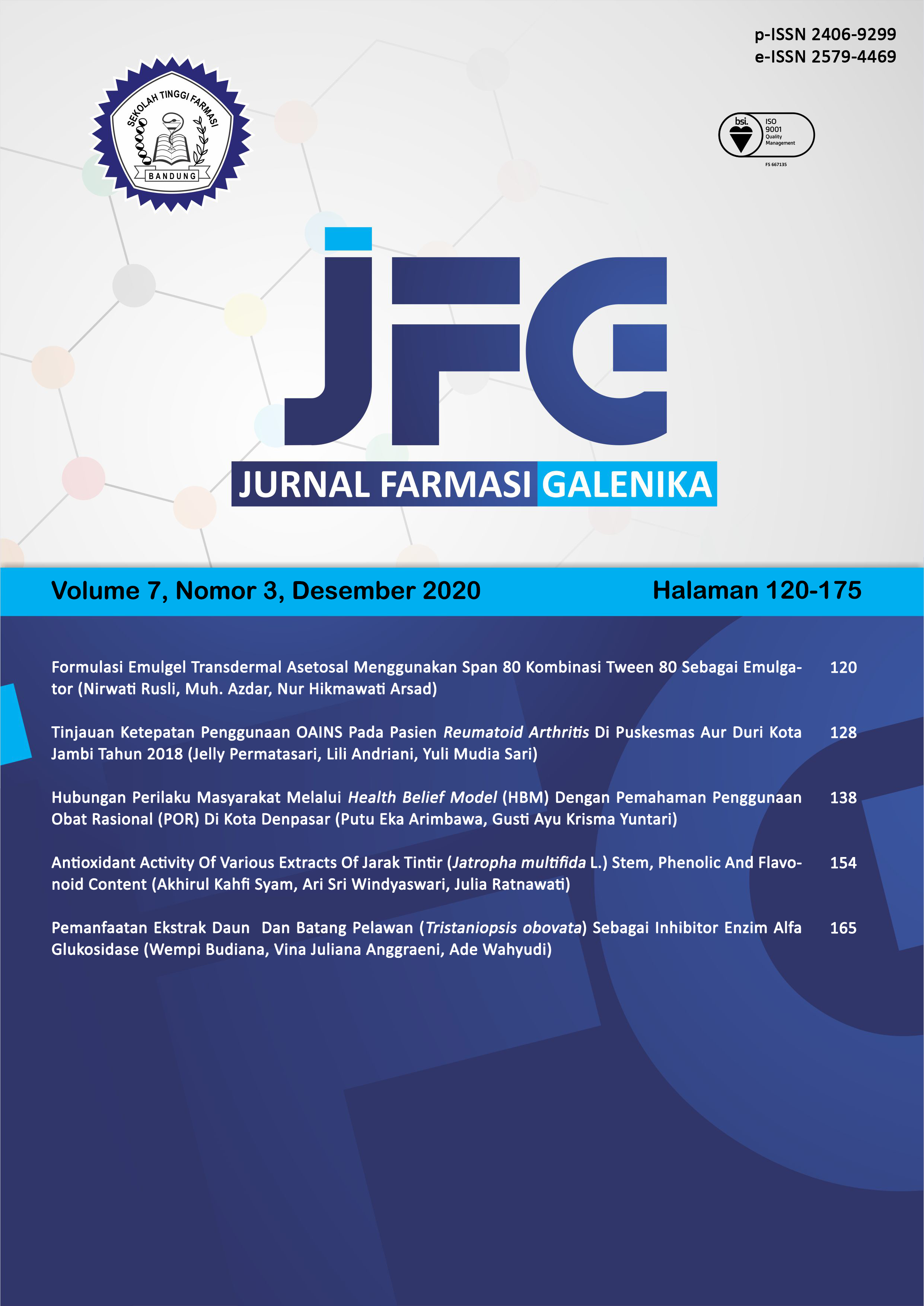
ANTIOXIDANT ACTIVITY OF VARIOUS EXTRACTS OF JARAK TINTIR (Jatropha multifida L.) STEM, PHENOLIC AND FLAVONOID CONTENT
DOI:
https://doi.org/10.70410/jfg.v7i3.182Keywords:
Antioxidant, DPPH, Jatropha multifida L., phenolic, flavonoidAbstract
Background: Jarak tintir (Jatropha multifida L.) was identified as one of family Euphorbiaceae and used by Indonesian people as traditional medicine. This study aimed to measure IC50 of inhibition DPPH as free radicals and make statistical analysis of flavonoid and phenolic content and correlation with their IC50 of free radicals. Methods: Hot continuous extraction was done with Soxhlet apparatus using various polarity solvents (n-hexane, ethyl acetate, and methanol). Results: Methanol extract had the lowest IC50 32.26 ± 0.37 µg/mL of DPPH inhibition activity. Ethyl acetate extract had highest phenolic and highest flavonoid content with 35.21 ± 1.50 mg TAE/g extract and 49.41 ± 1.65 mg QE/g extract. Conclusion: Flavonoid and phenolic content in extracts had linier correlation with their IC50 of inhibition free radicals.
Downloads
References
Chang, Chia-Chi, Ming-Hua Yang, dan Hwei-Mei Wen. 2002. “Estimation of Total Flavonoid Content in Propolis by Two Complementary Colorimetric Methods.” Journal of Food and Drug Analysis 10(3):178–82.
Cheung, L. M., Peter C. K. Cheung, dan Vincent E. C. Ooi. 2003. “Antioxidant activity and total phenolics of edible mushroom extracts.” 81:249–55.
Depkes RI. 2000. Paramater Standar Umum Ekstrak Tumbuhan Obat. Jakarta: Departemen Kesehatan RI.
Farnsworth, N. R. 1966. “Biological and phytochemical screening of plants.” Journal of Pharmaceutical Sciences 55(3):225–76.
Fidrianny, Irda, Tiara Aristya, dan Rika Hartati. 2015. “Antioxidant Capacities of Various Leaves Extracts from Three Species of Legumes and Correlation with Total Flavonoid , Phenolic , Carotenoid Content.” International Journal of Pharmacognosy ang Phytochemical Reasearch 7(3):628–34.
Foote, C. .. 1976. Free radicals in biology. 3rd ed. New York: Academic Press.
Ghasemzadeh, Ali, Hawa Z. E. Jaafar, dan Asmah Rahmat. 2010. “Antioxidant Activities, Total Phenolics and Flavonoids Content in Two Varieties of Malaysia Young Ginger (Zingiber officinale Roscoe).” 4324–33.
Heim, Kelly E., Anthony R. Tagliaferro, dan Dennis J. Bobilya. 2002. “Flavonoid antioxidants: Chemistry, metabolism and structure-activity relationships.” Journal of Nutritional Biochemistry 13(10):572–84.
Hutapea, J. 2000. Inventaris Tanaman Obat Indonesia. 2 ed. Vol. 1. Jakarta: Departemen Kesehatan RI dan Badan Penelitian dan Pengembangan Kesehatan.
Katalinic, V., M. Milos, T. Kulisic, dan M. Jukic. 2006. “Food Chemistry Screening of 70 medicinal plant extracts for antioxidant capacity and total phenols.” 94:550–57.
Molyneux, P. 2004. “The Use of the Stable Free Radical Diphenylpicryl-hydrazyl (DPPH) for Estimating Antioxidant Activity.” Songklanakarin Journal of Science and Technology 26:211–219.
Pourmorad, F., S. J. Hosseinimehr, dan N. Shahabimajd. 2006. “Antioxidant activity , phenol and flavonoid contents of some selected Iranian medicinal plants.” African Journal of Biotechnology 5(June):1142–45.
Rampadarath, Sillma, Daneshwar Puchooa, dan Vijayanti Mala Ranghoo-Sanmukhiya. 2014. “A comparison of polyphenolic content, antioxidant activity and insecticidal properties of Jatropha species and wild Ricinus communis L. found in Mauritius.” Asian Pacific Journal of Tropical Medicine 7(Suppl 1):S384–90.
Rampadarath, Sillma, Daneshwar Puchooa, dan Vijayanti Mala Ranghoo. 2014. “Antimicrobial, phytochemical and larvicidal properties of Jatropha multifida Linn.” Asian Pacific Journal of Tropical Medicine 7(7 (Suppl 1)):380–83.
Syam, Akhirul Kahfi, Muhammad Insanu, dan Komar Ruslan Wirasutisna. 2017. “Isolation of 8-Hidroxy-6 , 7-Dimethoxy Coumarin from Jarak Tintir Stem ( Jatropha Multifida L .) and Its Toxicity Value Using Brine Shrimp Lethality Test ( BSLT ).” Traditional Medicine Journal 22(1):21–24.
Waksmundzka-Hajnos, Monika, Joseph Sherma, dan Teresa Kowalska. 2008. “Overview of the Field of TLC in Phytochemistry and the Structure of the Book.” Hal. 3–9 in Thin Layer Chromatography in Phytochemistry, diedit oleh Monika.
Downloads
Published
How to Cite
Issue
Section
Citation Check
License
Copyright (c) 2020 JURNAL FARMASI GALENIKA

This work is licensed under a Creative Commons Attribution 4.0 International License.
Authors who publish in Jurnal Farmasi Galenika agree to the following terms:
This license enables reusers to distribute, remix, adapt, and build upon the material in any medium or format, so long as attribution is given to the creator. The license allows for commercial use. CC BY includes the following elements:

BY: credit must be given to the creator.
You are free to:
- Share — copy and redistribute the material in any medium or format for any purpose, even commercially.
- Adapt — remix, transform, and build upon the material for any purpose, even commercially.
- The licensor cannot revoke these freedoms as long as you follow the license terms.
Under the following terms:
- Attribution — You must give appropriate credit , provide a link to the license, and indicate if changes were made . You may do so in any reasonable manner, but not in any way that suggests the licensor endorses you or your use.
- No additional restrictions — You may not apply legal terms or technological measures that legally restrict others from doing anything the license permits.
Notices:
You do not have to comply with the license for elements of the material in the public domain or where your use is permitted by an applicable exception or limitation .
No warranties are given. The license may not give you all of the permissions necessary for your intended use. For example, other rights such as publicity, privacy, or moral rights may limit how you use the material.


1.jpg)